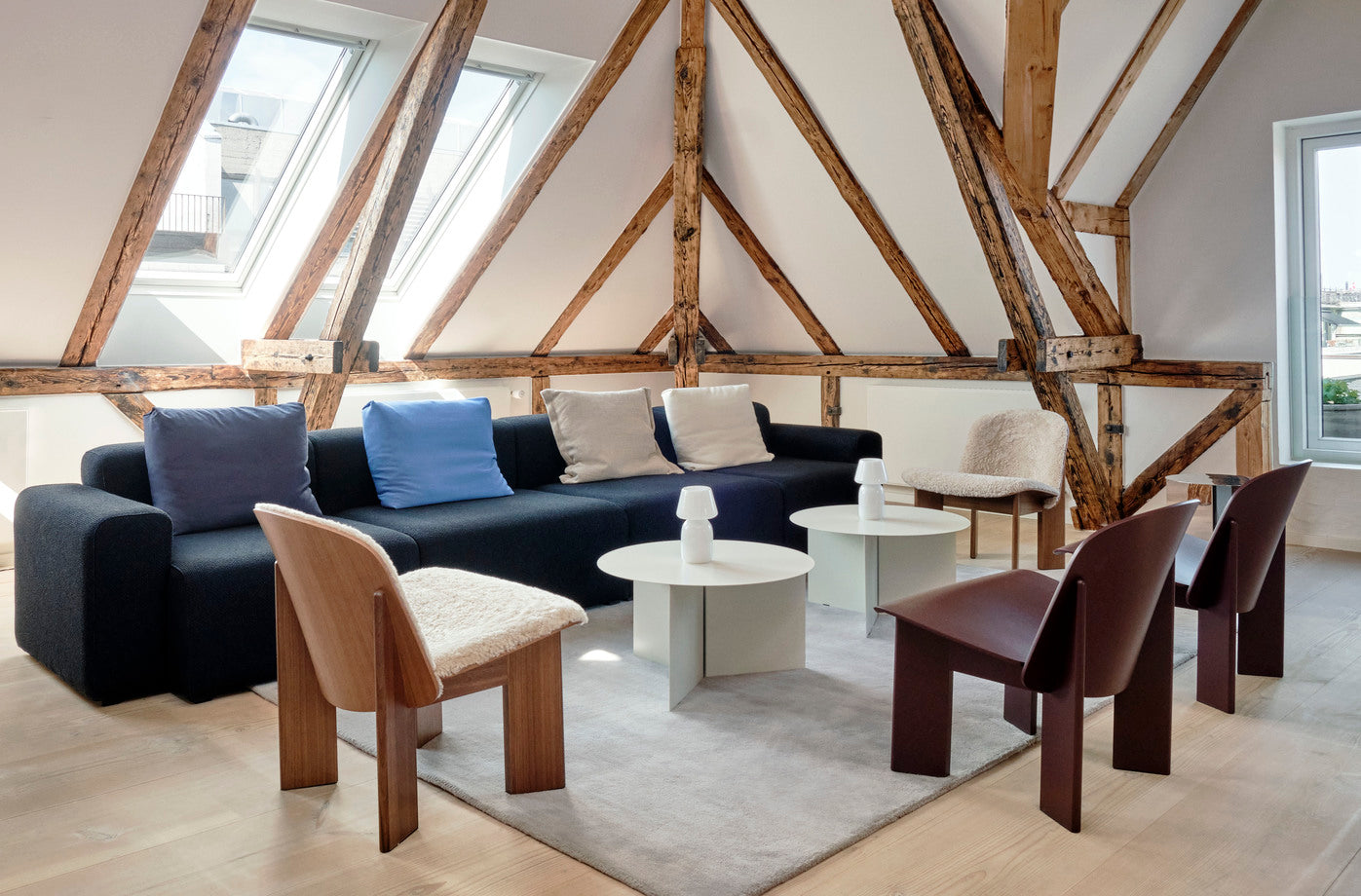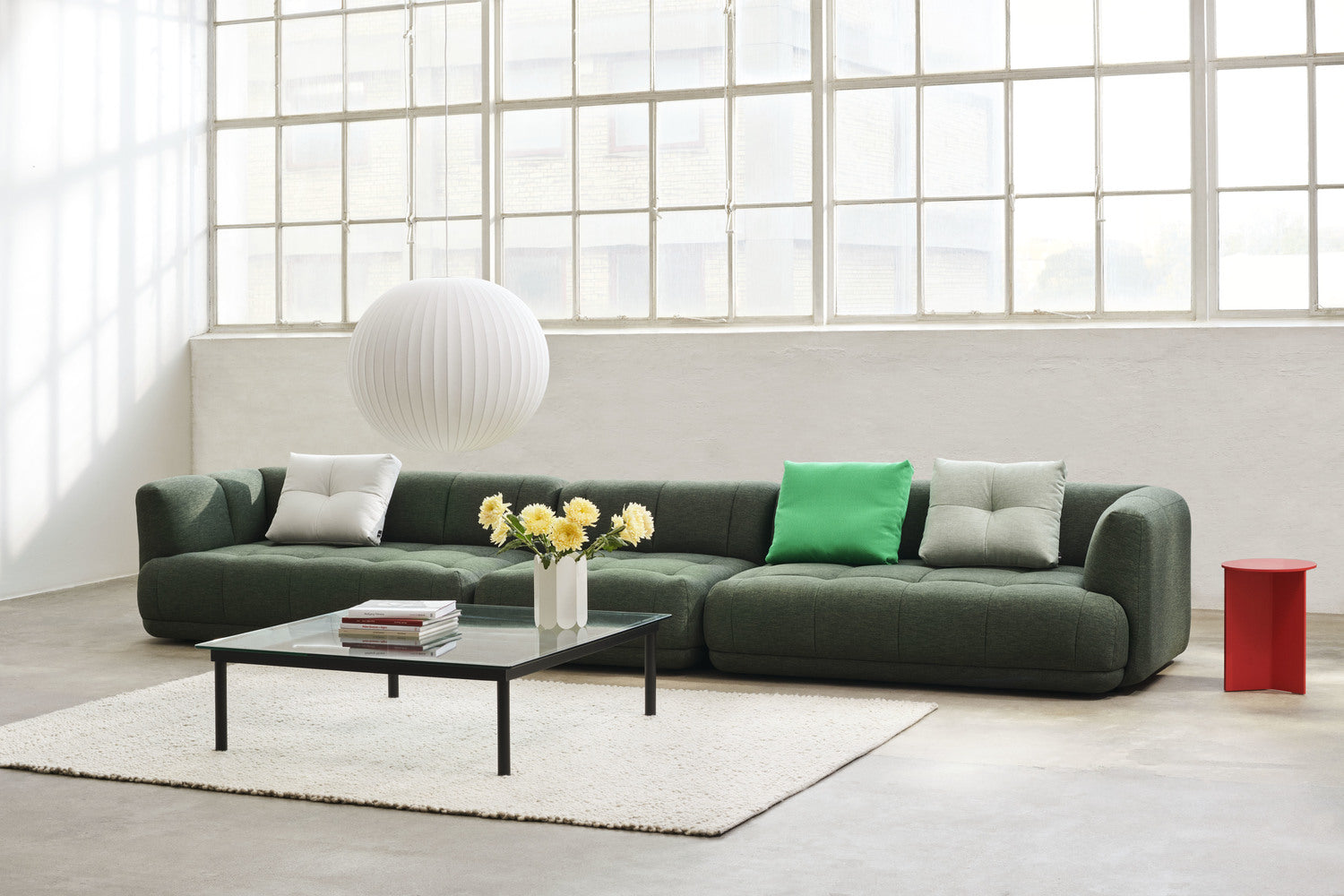
A sofa has to do several jobs at once. It should feel comfortable, work with the proportions of the room and suit the way you live. Before comparing colours or fabrics, it helps to make a few practical decisions about size, support and configuration.
How will you use the sofa?
Start with everyday use rather than appearance. A sofa for sitting upright with guests has different requirements from one used for relaxed evenings, reading or occasional naps.
- How many people will usually sit on it?
- Do you prefer to sit upright or put your feet up?
- Will children or pets use it?
- Does it need to provide an occasional sleeping space?
- Will it be the room’s main sofa or additional seating?
If several people use the sofa differently, look for a balanced design: supportive enough for upright sitting, but with sufficient depth and softness for relaxing. A chaise, ottoman or modular arrangement can also give you more than one way to sit without making the entire sofa unusually deep.
What size sofa will fit the room?
The stated width is only the starting point. Check the sofa’s overall width, depth and height, then consider the space it needs around it.
Marking the footprint on the floor with masking tape is one of the simplest ways to judge scale. Live with the outline for a day if possible. Walk around it, open nearby doors and drawers, and check that it does not interrupt the main route through the room.
Pay particular attention to depth. Two sofas with a similar width can occupy the room very differently if one projects much further forward. Wide arms can also make a sofa look generous while leaving less usable seating space, so compare the internal seat width as well as the overall dimensions.
In an open-plan room, a sofa can help define the seating area. In a smaller room, a raised frame, slimmer arms or visible floor beneath the sofa may make the layout feel less crowded.
What seat depth should you choose?
Seat depth has a significant effect on how a sofa feels.
A shallower seat generally supports a more upright position and can be comfortable for conversation, reading or anyone who prefers their feet to rest naturally on the floor. A deeper seat encourages a more relaxed posture and gives you room to curl up, but shorter users may need a cushion behind their back for support.
Remember that the published overall depth and the usable seat depth are not the same measurement. The backrest and cushions account for part of the total, so check both figures where they are available.
Seat height matters too. A lower sofa can feel relaxed and visually understated, while a higher seat may be easier to get in and out of. Your height, preferred posture and the firmness of the cushions will all affect the result.
Do you prefer soft or structured comfort?
Comfort is not simply a choice between firm and soft. It also depends on cushion construction, seat angle, depth and the amount of support provided by the backrest.
A structured sofa tends to hold its shape and support a more upright sitting position. It may also require less frequent dressing. Softer cushioning creates a more relaxed feel, but usually develops creases and needs occasional plumping or repositioning.
Consider how you want the sofa to look after regular use. If you enjoy a neat, tailored appearance, a firmer seat and fixed cushions may suit you. If comfort and an informal character matter more, a softer design may be the better choice.
Neither approach is inherently more comfortable. The useful question is whether you prefer to sit on the sofa or settle into it.
Should you choose a fixed or modular sofa?
A fixed sofa is straightforward: its proportions and seating arrangement have already been resolved. It is often the simplest choice for a clearly defined space or a conventional two- or three-seat layout.
A modular sofa is assembled from individual seating, corner, chaise or ottoman elements. This can work particularly well in larger rooms, awkward layouts or homes where the arrangement may need to change. Some systems also allow modules to be added later, although the availability of matching fabrics and finishes should be checked before relying on future expansion.
Modular does not automatically mean large. A compact two-module arrangement can make efficient use of a smaller room, while a chaise configuration may offer relaxed seating without requiring space for a separate footstool.
When comparing configurations, look closely at where the joins fall, whether the chosen end modules include arms, and which direction a chaise or corner faces. Product diagrams are more reliable than names such as left-hand or right-hand, which can be interpreted differently.
The HAY sofa collection includes fixed and modular options, while Muuto sofas offer further ways to compare different proportions and levels of support.
Which upholstery should you choose?
Choose upholstery according to use, maintenance and texture as well as colour.
For a frequently used family sofa, look closely at the fabric specification and care instructions. A tightly woven textile may be more practical around children or pets than a fabric with a loose weave or pronounced surface texture. Patterned or softly mottled fabrics can be more forgiving of everyday marks than very pale, uniform colours.
Natural fibres often feel tactile and breathable, while synthetic fibres or blended textiles may offer greater resistance to abrasion or staining. The fibre content alone does not tell the whole story: weave, colour, finish and cushion construction all affect performance.
Always request a fabric sample when possible. Colours can look different under warm artificial light, cool daylight and direct sun. Place the sample in the room at different times of day and view it alongside the flooring, curtains and other large surfaces.
If the sofa will sit in strong sunlight, ask about colourfastness and expect some materials to change over time. Follow the manufacturer’s care guidance rather than applying a general-purpose cleaning product without checking its suitability.
How should the sofa relate to the rest of the room?
A sofa is usually one of the room’s largest visual elements, but it does not need to dominate it.
Begin with proportion. A substantial, low sofa can anchor a generous space, while a more compact frame may sit comfortably alongside lighter furniture. Consider the height of windowsills, radiators, side tables and other seating, as well as the sofa’s position in relation to the television or fireplace.
Allow enough space between the sofa and coffee table to move comfortably while keeping the table within reach. If the sofa will float away from the wall, check the appearance of its back and leave a clear route behind it where required.
Colour should be considered across the whole room. A neutral sofa can provide a calm foundation, while a stronger colour may give the seating area greater definition. In either case, texture often has as much impact as hue.
Will the sofa fit through the door?
Measure the full delivery route before ordering, not just the final position.
- External and internal door widths
- Hallways and tight turns
- Stair width, ceiling height and landings
- Lift dimensions and weight restrictions
- Low light fittings, radiators and bannisters
- Access from the delivery vehicle to the property
Compare these measurements with the packaged dimensions where available. Removable legs may help, but do not assume that arms, backs or other parts can be detached unless the product information confirms it.
For flats, upper floors or properties with restricted access, speak to us before ordering. Modular sofas can sometimes be easier to deliver because they arrive in smaller sections, but each individual module still needs to be checked against the route.
Should comfort or appearance come first?
A well-chosen sofa should satisfy both, but comfort deserves particular weight because it is difficult to judge from photographs.
Notice how you naturally sit. Test whether the backrest supports you, whether the front of the seat presses behind your knees and whether you can stand up comfortably. If two people of different heights will use the sofa regularly, both should try it where possible.
It is also worth accepting that upholstered furniture changes with use. Cushions soften, fabrics crease and surfaces develop character. This is normal, particularly with softer designs. Choose a sofa whose lived-in appearance you will enjoy, rather than judging it only when perfectly dressed.
The best sofa is not necessarily the largest, softest or most striking option. It is the one whose proportions, support and materials continue to work once it becomes part of everyday life.
Choosing your sofa
Choosing a sofa becomes easier when you decide how it should function before comparing finishes. Measure the room and delivery route carefully, understand your preferred sitting position, and compare the usable seat dimensions rather than relying on labels such as two-seater or three-seater.
When those practical decisions are right, colour and upholstery become a much more manageable — and enjoyable — choice.
Find the right sofa for your space. Explore kin.’s sofa collection, or contact us if you would like help comparing dimensions, fabrics and configurations.