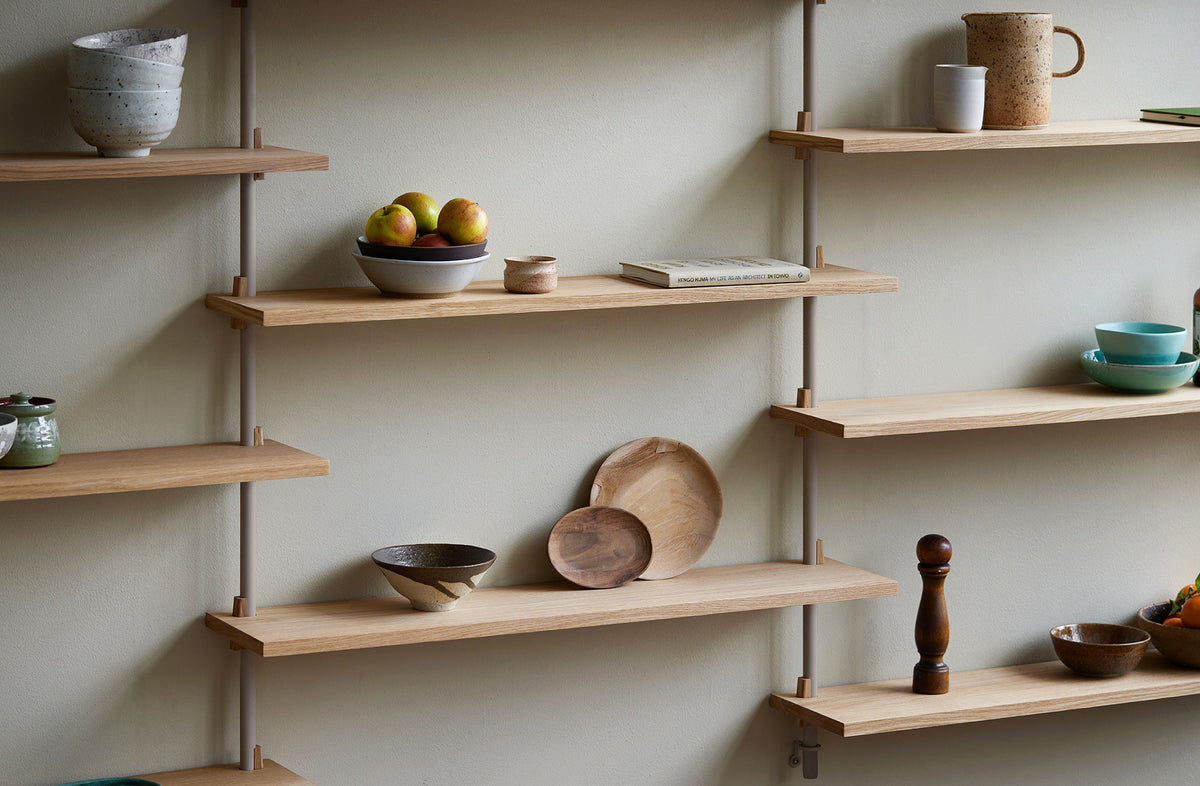
Useful storage begins with what needs to be kept, not with an empty wall. Books, records, tableware and everyday clutter place different demands on shelf depth, strength and access. Once those needs are clear, it becomes easier to choose between open shelves, closed cabinets and a modular system.
What needs to be stored?
Measure the largest and heaviest items, then group possessions by how often they are used. Everyday objects should remain easy to reach; items that create visual noise often benefit from a door or drawer.
Allow some spare capacity. Shelving filled edge to edge from the start is difficult to use and leaves no room for the collection to change.
Measure representative groups rather than one object. A shelf for records needs enough continuous width, finger room and appropriate support; a shelf for tableware must accommodate stacks and the movement required to lift them safely. Cables and ventilation need their own allowance.
Open shelving or closed storage?
Open shelves keep books and display pieces visible and can make a narrow room feel lighter. They also require more regular dusting and a degree of editing. Closed cabinets conceal cables, paperwork and less decorative objects, but have greater visual weight.
A combination is often the most practical: open space above, with doors or drawers at a lower level.
Place closed storage where its doors remain easy to use. A cabinet at floor level may clash with a rug or coffee table, while a wall-mounted door can meet a lamp or screen. Draw the open position as well as the closed elevation.
How deep should shelves be?
Shelf depth should follow the objects rather than defaulting to the deepest option. Paperbacks and small objects need less depth than large art books, records or serving pieces. In a corridor or compact room, a shallower system can preserve valuable floor space.
Fixed unit or modular system?
A fixed cabinet is straightforward where the storage requirement and location are unlikely to change. A modular system can expand, incorporate desks or cabinets and adapt to another room, but it requires more careful planning at the outset.
With any system, confirm compatibility between components and finishes before ordering additions.
Modularity is most valuable when the initial arrangement already works. Do not leave awkward gaps or omit essential closed storage on the assumption that it will be added later; components and finishes can change, and future expansion cannot be guaranteed.
What should you check before installation?
Confirm the overall assembled dimensions, skirting-board clearance and the position of sockets. Wall-mounted and tall units must be installed using fixings appropriate to the wall construction. If you are uncertain, use a qualified installer.
Check the manufacturer’s maximum loads and distribute weight as instructed. Heavy books and equipment are best kept lower where the design permits.
Delivery access also matters for apparently simple storage. Check the longest shelf, side panel and assembled cabinet against stairs and turns. Confirm whether a unit is built in the room and how much clear floor the installer will need.
How do you make shelves feel considered?
Leave breathing room and vary the height of objects rather than filling every gap. Place frequently handled items where they remain convenient. Good storage should improve the room’s function first; display follows from that.
Use fewer, larger groups rather than scattering small objects evenly across every shelf. Books can provide structure; one clear object or a patch of empty space gives the eye somewhere to rest. The arrangement should still be quick to clean and easy to change.
Choosing shelving and storage
Measure the objects, available wall and access route. Decide what should be visible, what should be concealed and whether the system needs to change over time.
Make better use of your walls. Explore our cabinets and shelving, or contact us for help planning a modular arrangement.